






Posted At: Nov 13, 2026 - 9 Views
The global agriculture and food supply chain is facing increasing pressure from climate change, unpredictable weather conditions, geopolitical disruptions, rising production costs, labor shortages, and changing consumer expectations. From farmers and agricultural producers to food processors, distributors, retailers, and consumers, every stage of the food ecosystem depends on a complex network of interconnected operations. When one part of this network experiences disruption, the effects can spread across markets, affecting food availability, prices, production schedules, and business performance.
Traditional supply chain management approaches often struggle to respond quickly to these challenges because they rely heavily on historical information, manual processes, and fragmented data systems. Organizations need better visibility, faster decision-making, and the ability to anticipate risks before they affect operations. Artificial Intelligence (AI) is emerging as an important technology in this transformation.
By combining predictive analytics, machine learning, automation, satellite data, and real-time monitoring, AI can help agriculture and food businesses identify potential disruptions, improve resource planning, optimize logistics, and strengthen operational resilience. The goal is not simply to make supply chains more efficient but to build systems that can adapt, recover, and continue delivering essential food products during uncertain conditions.
Understanding the Challenges Facing Global Food Supply Chains
Agriculture and food supply chains operate across multiple regions, industries, and transportation networks. Their performance depends on environmental conditions, infrastructure, labor availability, market demand, and international trade. This complexity makes them particularly vulnerable to unexpected disruptions.
Climate Change and Unpredictable Weather
Extreme weather events such as droughts, floods, heatwaves, and storms can significantly affect agricultural productivity. Changes in rainfall patterns and rising temperatures may influence planting schedules, crop quality, irrigation requirements, and harvesting periods. These challenges can create uncertainty for farmers and food manufacturers that depend on consistent agricultural output.
Climate-related disruptions can also affect transportation infrastructure, storage facilities, and distribution networks. AI-powered forecasting systems can help organizations analyze weather patterns, historical crop information, and environmental data to identify potential risks and prepare alternative plans.
Geopolitical and Trade Disruptions
Global food supply chains depend on international trade, cross-border transportation, and the availability of agricultural inputs such as fertilizers, seeds, fuel, and machinery. Trade restrictions, political instability, conflicts, and changing regulations can interrupt the movement of essential goods.
These disruptions may increase procurement costs, delay shipments, and limit access to important resources. Organizations need greater visibility into supplier networks and market conditions to understand where risks may emerge and how they could affect business operations.
Rising Costs and Changing Consumer Demand
Agricultural businesses and food manufacturers must manage fluctuating prices for raw materials, energy, packaging, labor, and transportation. At the same time, consumer preferences continue to evolve, creating demand for fresher products, greater transparency, sustainable sourcing, and reliable availability.
When businesses cannot accurately forecast demand, they may experience excess inventory, food waste, shortages, and financial losses. Better demand intelligence is therefore essential for maintaining a balanced and resilient food supply chain.
How AI Is Strengthening Agriculture and Food Supply Chain Resilience
AI provides organizations with the ability to analyze large volumes of information, identify patterns, and support faster operational decisions. When integrated across agricultural production, processing, storage, and distribution, these capabilities can improve visibility and help businesses respond more effectively to uncertainty.
AI-Powered Crop Monitoring and Predictive Agriculture
Crop production is one of the most important foundations of the global food supply chain. However, agricultural output can vary because of soil conditions, water availability, pests, diseases, and weather changes.
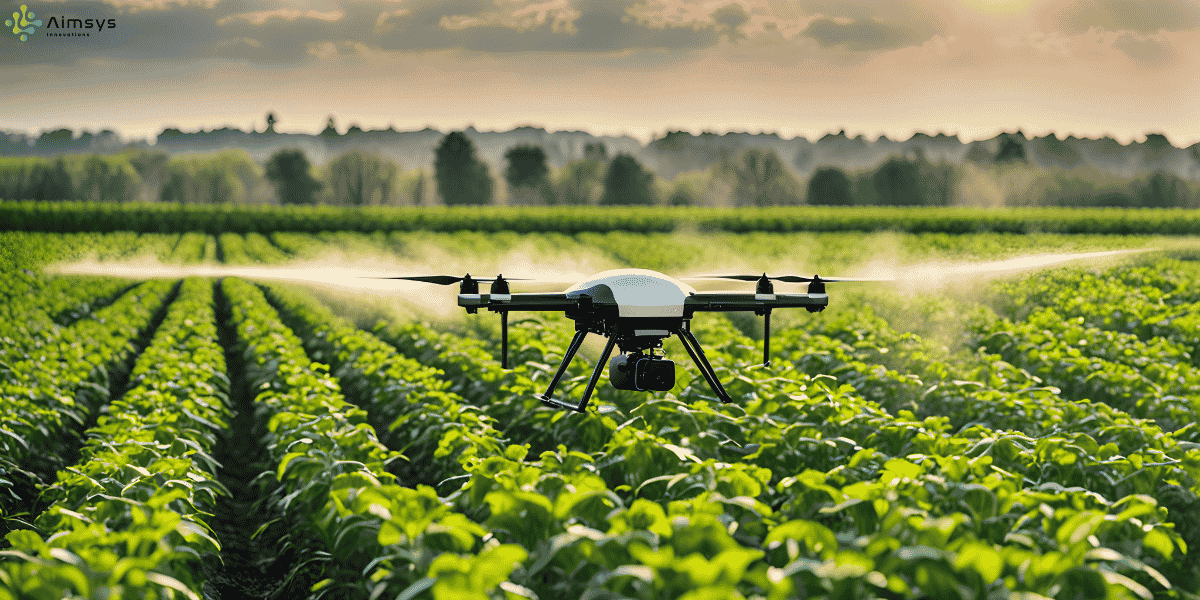
AI-powered agricultural systems can analyze satellite imagery, drone observations, soil measurements, and weather information to monitor crop health and identify potential problems. Machine learning models can help detect patterns associated with plant stress, disease risks, and changing field conditions.
These insights allow farmers to make more informed decisions about irrigation, fertilization, pest management, and harvesting. By identifying potential issues earlier, agricultural producers can reduce avoidable losses and improve the consistency of crop production.
Predictive Analytics for Supply Chain Risk Management
Supply chain disruptions are often difficult to manage because organizations may not recognize warning signs until operations are already affected. AI can strengthen risk management by analyzing information from suppliers, transportation networks, weather forecasts, market trends, and inventory systems.
Predictive analytics can help identify possible delivery delays, shortages of agricultural inputs, demand fluctuations, and regional production risks. Businesses can use these insights to evaluate alternative suppliers, adjust procurement plans, and prepare contingency strategies.
For example, if weather conditions indicate a possible disruption in a major agricultural region, food manufacturers may review their sourcing plans and explore alternative supply options before shortages become more severe. This proactive approach can reduce dependence on reactive decision-making.
Intelligent Demand Forecasting and Inventory Optimization
Accurate demand forecasting is essential for maintaining the balance between food availability and inventory costs. Traditional forecasting methods may struggle when consumer demand changes quickly or when external disruptions affect purchasing patterns.
AI models can examine historical sales, seasonal trends, regional demand, weather conditions, pricing changes, and other relevant signals to generate more responsive forecasts. Retailers and food manufacturers can use these predictions to improve purchasing decisions, production planning, and inventory allocation.
Better forecasting can help organizations reduce overstocking, avoid unnecessary shortages, and improve product availability. It can also support more efficient management of perishable goods, where delays and inaccurate inventory decisions can lead to significant food waste.
AI-Driven Logistics and Transportation Management
The movement of agricultural products and food items involves multiple transportation stages, including collection, processing, warehousing, and retail distribution. Delays, fuel price fluctuations, poor route planning, and infrastructure problems can increase costs and affect product quality.
AI-powered logistics platforms can analyze traffic information, delivery schedules, vehicle capacity, fuel consumption, and weather conditions to support route optimization. These systems can help logistics teams identify more efficient delivery options and respond to changing transportation conditions.
For temperature-sensitive products, AI can also support cold-chain monitoring by analyzing sensor data from storage facilities and transportation equipment. Alerts about temperature changes or equipment irregularities can help businesses investigate problems before product quality is compromised.
Reducing Food Waste Through Intelligent Analytics
Food waste remains a major challenge across agricultural production, processing, storage, retail, and consumption. Products may be lost because of inaccurate demand forecasts, poor storage conditions, transportation delays, or inefficient inventory management.
AI can help organizations identify where waste is most likely to occur. Predictive models can estimate product shelf life, monitor storage conditions, and support inventory rotation decisions. Retailers can use demand insights to improve ordering quantities, while food processors can better coordinate production with market requirements.
By connecting information across different supply chain stages, organizations can make better decisions about storage, distribution, and product allocation. These improvements can support both business efficiency and broader sustainability objectives.
The Role of AI in Agricultural Sustainability
Resilience and sustainability are closely connected. A food supply chain that uses resources efficiently and reduces environmental pressure is better positioned to manage long-term challenges.
Smarter Water and Resource Management
Water availability is a critical factor in agricultural productivity, particularly in regions experiencing drought and increasing competition for freshwater resources. AI-based irrigation systems can combine soil moisture readings, weather forecasts, and crop requirements to support more informed irrigation decisions.
These insights can help farmers avoid unnecessary water consumption while maintaining suitable growing conditions. Similar approaches can support more efficient fertilizer and energy management, reducing resource waste and improving agricultural operations.
Supporting Sustainable Farming Practices
AI can help farmers monitor soil conditions, detect crop diseases, and identify areas requiring targeted treatment. Instead of applying resources uniformly across entire fields, agricultural producers can use data-driven insights to make more precise decisions.
Precision agriculture can support improved resource utilization and reduce unnecessary chemical applications. When combined with responsible farming practices and expert supervision, AI can contribute to more sustainable agricultural production.
Why Data Integration Is Essential for AI-Driven Resilience
Although AI offers significant opportunities, its effectiveness depends on the quality, availability, and integration of data. Agricultural producers, suppliers, manufacturers, logistics providers, and retailers often operate separate systems. This fragmentation can make it difficult to develop a complete view of supply chain operations.
Organizations need connected data environments that bring together information from farm management platforms, enterprise resource planning systems, warehouse management solutions, transportation networks, weather services, and inventory applications.
A stronger data foundation allows AI systems to analyze relationships across different operations and generate more useful insights. It also improves coordination between supply chain partners, helping organizations respond to disruptions with better information.
However, data integration requires clear standards, appropriate access controls, data governance, and reliable infrastructure. Without these foundations, even advanced AI applications may produce incomplete or unreliable recommendations.
Challenges in Implementing AI Across Agriculture and Food Supply Chains
Despite its potential, AI adoption across the global food ecosystem involves several practical challenges.
Limited Digital Infrastructure and Technology Access
Many agricultural producers, particularly smaller farms and businesses in developing regions, may have limited access to reliable internet connectivity, digital tools, sensors, and advanced analytics platforms. These limitations can make large-scale AI adoption difficult.
Organizations must consider affordable and accessible solutions that can support different operational environments rather than relying exclusively on complex technology platforms.
Data Quality and Interoperability
AI models require relevant and reliable information to generate useful predictions. Inconsistent data formats, incomplete records, outdated systems, and limited data sharing can reduce the accuracy of AI-driven insights.
Businesses need to improve data collection practices, establish common standards, and create systems that allow information to move securely across supply chain partners.
Cybersecurity and Responsible AI Governance
As food supply chains become more digitally connected, the importance of cybersecurity increases. Agricultural data, supplier information, operational records, and logistics systems may become targets for cyber threats.
Organizations must establish appropriate security controls, access permissions, monitoring processes, and data protection policies. They should also ensure that AI recommendations can be reviewed and understood by responsible decision-makers.
Skills and Workforce Readiness
Successful AI adoption requires people who understand both the technology and the agricultural or operational processes it supports. Farmers, supply chain managers, analysts, and business leaders need appropriate training to interpret AI-generated insights and use them effectively.
Human expertise remains essential because AI predictions must be evaluated against real-world conditions, local knowledge, and business priorities.
Building a Resilient and AI-Ready Food Supply Chain
Developing an AI-driven supply chain requires more than introducing new software. Organizations need a coordinated strategy that connects technology investments with operational objectives.
Businesses should begin by identifying their most critical vulnerabilities, such as supplier concentration, limited inventory visibility, transportation delays, or unpredictable agricultural output. These challenges can help determine where AI applications may deliver meaningful value.
The next priority is establishing a reliable data foundation. Organizations should improve data quality, connect relevant systems, and create governance practices that support secure information sharing. Starting with focused applications, such as demand forecasting or crop monitoring, can help demonstrate value before expanding AI across additional operations.
Collaboration is equally important. Farmers, technology providers, food manufacturers, distributors, logistics companies, and retailers need to share relevant information and coordinate their decisions. Stronger collaboration can improve visibility and reduce the impact of disruptions across the wider ecosystem.
Most importantly, organizations should measure AI performance through practical business outcomes, including reduced food waste, improved forecast accuracy, lower transportation costs, stronger supplier visibility, and more reliable product availability.
The Future of AI-Driven Agriculture and Food Supply Chains
The future of agriculture and food distribution will increasingly depend on connected intelligence, predictive capabilities, and responsible automation. Advances in AI, Internet of Things (IoT) technologies, satellite monitoring, robotics, and digital platforms may create more responsive agricultural and supply chain ecosystems.
AI-enabled systems could help farmers make more precise production decisions, manufacturers coordinate operations with changing supply conditions, and retailers improve product availability. Digital twins may also support scenario planning by allowing organizations to evaluate potential disruptions and test alternative operational strategies in virtual environments.
As these technologies mature, organizations may gain better visibility across the entire journey of food products, from agricultural production to final delivery. However, technology alone cannot guarantee resilience. Investment in infrastructure, workforce development, collaboration, and responsible governance will remain equally important.
Conclusion
AI-driven resilience is becoming an important priority for the global agriculture and food supply chain. Climate uncertainty, geopolitical disruptions, changing consumer demand, and rising operational costs require businesses to move beyond traditional, reactive supply chain management.
Through predictive analytics, intelligent crop monitoring, demand forecasting, logistics optimization, and food waste reduction, AI can help organizations anticipate challenges and make better-informed decisions.
However, meaningful transformation depends on reliable data, connected systems, skilled professionals, and responsible technology adoption. The strongest supply chains will be those that combine AI capabilities with human expertise and collaboration across the food ecosystem.
The future of global food security will not depend only on producing more food. It will also depend on building smarter, more adaptable, and more resilient systems that can deliver food efficiently and sustainably, even in the face of uncertainty.