





Posted At: Sep 12, 2026 - 12 Views
Artificial intelligence is moving into a new stage of enterprise adoption. For years, businesses have used AI as a collection of tools that help employees write content, analyze data, automate repetitive tasks, and find information faster. These capabilities have already changed how people work, but the next transformation could be significantly broader.
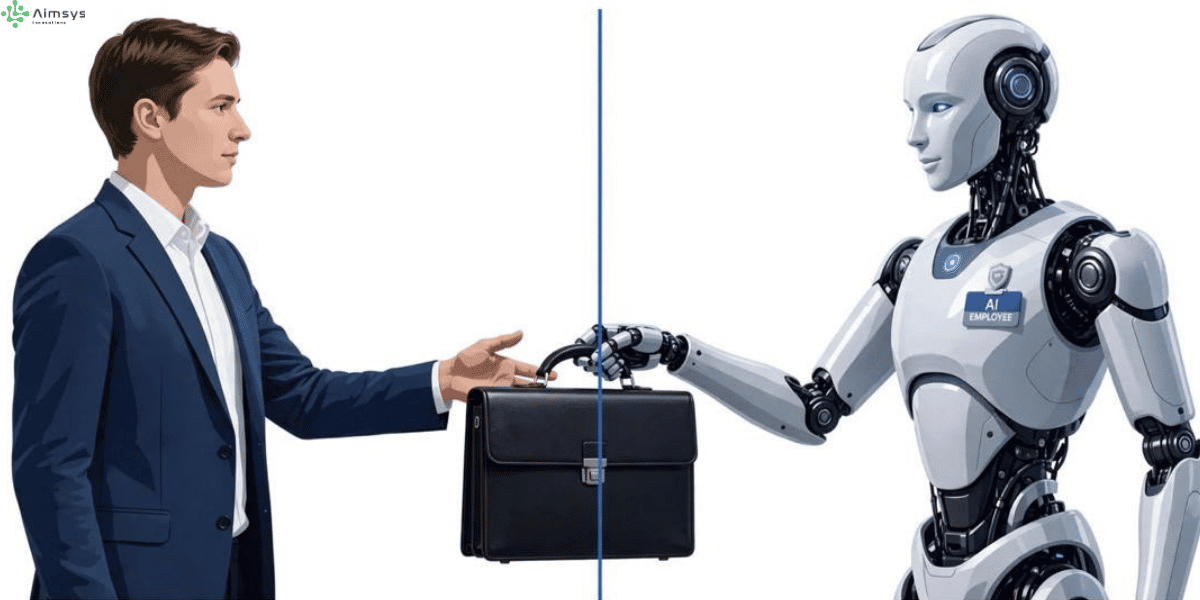
The emerging shift is from AI as a tool employees use to AI as a digital workforce that works alongside employees.
AI agents are increasingly capable of understanding objectives, reasoning through tasks, interacting with business systems, and completing multi-step workflows. This does not simply introduce another layer of automation. It changes how organizations can design processes, structure teams, and deliver business outcomes.
From AI Tools to AI Employees
Traditional AI tools generally wait for human instructions. An employee asks a question, provides information, or initiates a task, and the AI responds.
AI employees represent a different model. Instead of simply assisting with individual tasks, they can be designed around a business responsibility or workflow.
An AI system could potentially monitor information, identify an issue, determine the next action, interact with relevant systems, and escalate a decision when human judgment is required.
The Evolution of Enterprise AI
The progression can be understood in three stages:
AI Tools → AI Assistants → AI Agents
AI tools help people complete specific tasks. AI assistants provide more contextual support across workflows. AI agents take the concept further by operating toward defined objectives and coordinating multiple actions.
This evolution means businesses are beginning to think about AI not only in terms of software features, but also in terms of digital capabilities that can perform meaningful operational work.
What Makes an AI Employee Different?
Calling an AI system an “employee” does not mean it literally replaces a human worker. The term describes a shift in how organizations think about AI's role.
An AI employee can be designed to operate within a specific business function, with defined responsibilities, access permissions, workflows, and escalation rules.
AI Can Move From Responding to Acting
A conventional chatbot might answer a customer question. A more advanced AI agent could understand the customer's issue, retrieve relevant information, check an order, identify possible solutions, and initiate the appropriate workflow.
The important difference is action.
Instead of simply generating information, AI can increasingly become part of the operational process itself.
Digital Workers Can Operate Across Systems
Enterprise work rarely happens in one application. Employees may use CRM platforms, ERP systems, communication tools, analytics platforms, document repositories, and specialized business applications throughout the day.
AI agents can potentially connect these systems and coordinate activities across them.
This creates an opportunity to automate workflows that previously required employees to move information manually between multiple systems.
Reimagining the Modern Workforce
The arrival of AI employees does not necessarily mean organizations need fewer people. It can instead change how human talent is deployed.
Employees can spend less time on repetitive administrative work and more time on activities requiring judgment, creativity, relationships, and strategic thinking.
Humans Focus on What Requires Human Intelligence
AI is particularly useful when work involves large volumes of information, repetitive processes, pattern recognition, and structured workflows.
Humans remain essential when situations require:
Strategic judgment
Empathy and relationship building
Creativity
Complex problem-solving
Ethical decision-making
Leadership and accountability
The future workplace could therefore become a hybrid workforce, where human employees and AI agents contribute different strengths to the same business objectives.
Where AI Employees Can Create Business Value
The potential applications extend across almost every enterprise function.
Customer Service and Experience
AI employees can support customer-service operations by handling routine questions, summarizing interactions, finding relevant information, and initiating service workflows.
Human representatives can then focus on complex or sensitive customer situations where empathy and judgment are more important.
Sales and Marketing
AI agents can help monitor leads, research prospects, personalize communications, analyze campaign performance, and support sales teams with relevant insights.
Instead of spending hours collecting information, sales professionals can focus more heavily on relationships and high-value conversations.
Finance and Operations
Finance teams can use AI to assist with reporting, invoice processing, reconciliation, anomaly detection, and routine analysis.
Operations teams can similarly use AI agents to monitor workflows, identify exceptions, and coordinate repetitive processes across business systems.
IT and Enterprise Support
AI employees can support IT operations by monitoring systems, identifying potential issues, responding to common requests, and assisting with incident workflows.
This can allow human IT teams to concentrate on complex technical problems and strategic technology initiatives.
The Importance of Enterprise Data
AI employees are only as effective as the information and systems they can access.
An organization may have advanced AI models, but disconnected, outdated, or unreliable data can limit their ability to perform meaningful work.
Data Becomes the Foundation of Digital Workforces
AI agents need access to accurate business information, relevant context, and clearly defined processes.
This makes enterprise data modernization increasingly important. Businesses need to consider how data is collected, governed, integrated, and made available to AI systems.
The goal is not simply to give AI access to more data. It is to provide the right information, in the right context, with the right permissions.
AI Governance Becomes Workforce Governance
When AI moves from assisting employees to performing operational work, governance becomes even more important.
Organizations need to establish clear boundaries around what AI systems can access, decide, and execute.
Defining AI Responsibilities
Every AI employee should have a clearly defined scope of responsibility.
Organizations need to determine:
What tasks can AI perform independently?
Which decisions require human approval?
What information can the AI access?
When should an AI agent escalate an issue?
How are AI actions monitored and audited?
These questions become essential as AI systems gain greater autonomy.
Keeping Humans Accountable
AI may execute a process, but organizations still need clear human accountability for important business outcomes.
Human oversight is particularly important when decisions affect customers, employees, finances, compliance, security, or reputation.
The objective should be controlled autonomy, not unlimited autonomy.
Measuring the Value of AI Employees
Enterprise AI initiatives should ultimately be evaluated through business outcomes.
Traditional metrics such as the number of AI tools deployed or employees using AI provide only part of the picture.
Businesses should also consider whether AI is helping them:
Reduce operational costs, Improve productivity, Accelerate decision-making, Improve customer experiences, Reduce process delays, Increase employee capacity, Improve accuracy and consistency, Create new revenue opportunities
The most successful organizations will connect AI deployment directly to measurable business priorities.
Preparing the Organization for AI Employees
The transition toward digital workforces requires more than adopting new technology. It requires organizations to rethink processes and operating models.
Start With the Workflow, Not the Technology
Instead of asking, “Where can we use AI?”, business leaders should ask:
“Which business processes could become significantly better if intelligent digital workers handled part of the work?”
This approach helps organizations identify use cases where AI can create meaningful value rather than introducing technology without a clear purpose.
Build the Foundation Before Scaling
Organizations should establish strong data, integration, security, governance, and monitoring capabilities before expanding AI agents across critical operations.
A controlled approach allows businesses to experiment, measure results, learn from failures, and gradually increase AI autonomy.
The New Business Model: Human Teams and Digital Teams
As AI capabilities mature, companies may begin to think about their workforce differently.
A business team could include human employees supported by specialized AI agents—for example, a sales team working with an AI research agent, a customer-service agent, and an analytics agent.
Each AI system could handle specific responsibilities while humans remain responsible for broader objectives and decisions.
This model could create a more flexible organization where digital capacity can scale alongside business demand.
What CEOs and CTOs Should Consider
For business and technology leaders, the transition from AI tools to AI employees raises a bigger strategic question: How should the organization be redesigned when intelligent digital workers become part of everyday operations?
Leaders should focus on building an environment where AI can operate safely and effectively while employees understand how to collaborate with it.
The organizations that gain the most value may not be those that deploy the largest number of AI agents. They may be the ones that redesign their operating models around the right combination of human and digital capabilities.
The Next Transformation of Business
AI is moving beyond productivity software and into the operational core of enterprises. The next wave will not simply be about giving employees better tools. It will be about creating intelligent digital workers that can participate in business processes, coordinate tasks, and operate alongside human teams.
This transformation will require organizations to rethink technology, data, workforce design, governance, and leadership.
The future of work is unlikely to be entirely human or entirely autonomous.
It will be a collaborative workforce where humans provide direction, judgment, creativity, and accountability while AI provides intelligence, speed, scale, and execution.
For businesses willing to build the right foundations today, the move from AI tools to AI employees could become one of the most significant transformations of the modern enterprise.